Classroom resources · printable
Print it. Play it. Think with it.
Every free ARQIV lesson, kit and printable in one place: games, task cards, posters, bell ringers, complete lessons, a six-week unit and the AI Learning Center guides, for grades 6–12. Filter by grade and type; each card lists time, prep and what’s in the file.
Free to use
Free to download, print and teach.
Every resource on this page is free and stays free. Print and copy it for the students you teach; please link to this page rather than re-posting the files.
Tell us what worked and what didn’t. Your feedback shapes every new kit.
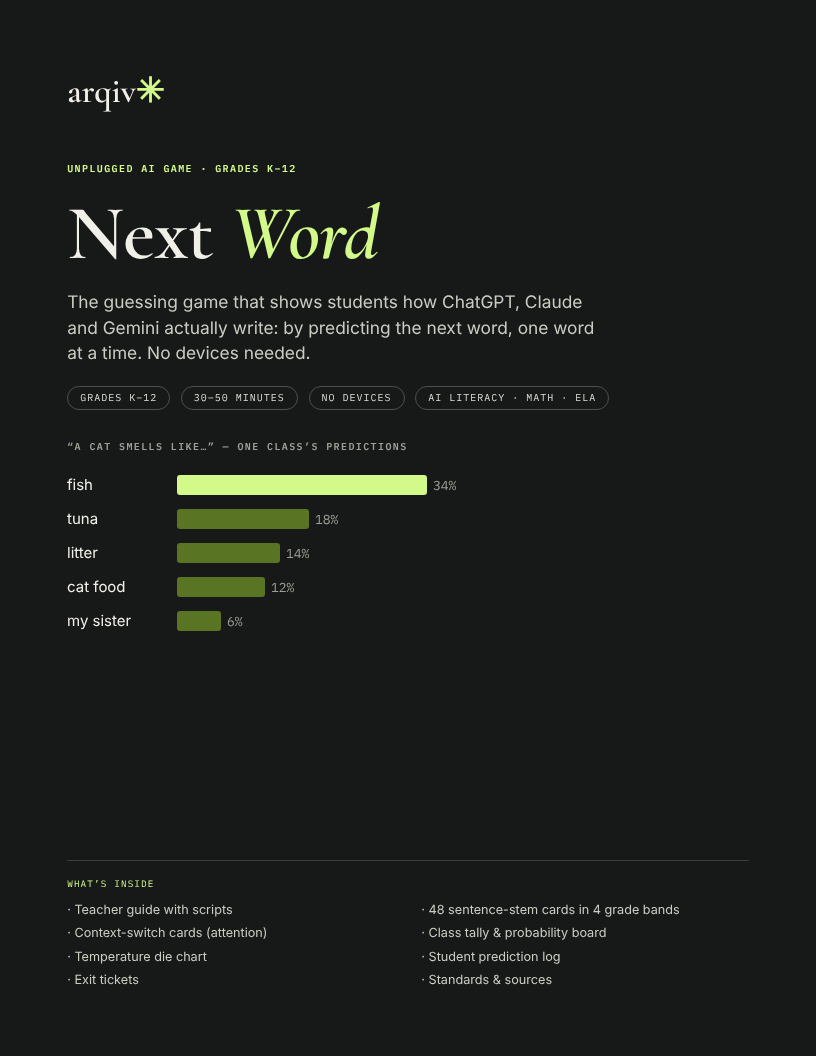
Next Word: The Transformer Game
Students act as a language model: guess the next word, tally the class and compute probabilities. They learn how ChatGPT-style AI writes, why context matters (attention), and why “most likely” isn’t “true.”
What’s inside
- Teacher guide with scripts for 5 rounds
- 48 sentence-stem cards in 4 grade bands
- Context-switch cards (attention)
- Class tally & probability board
- Temperature die chart
- Prediction log, exit tickets, answer notes
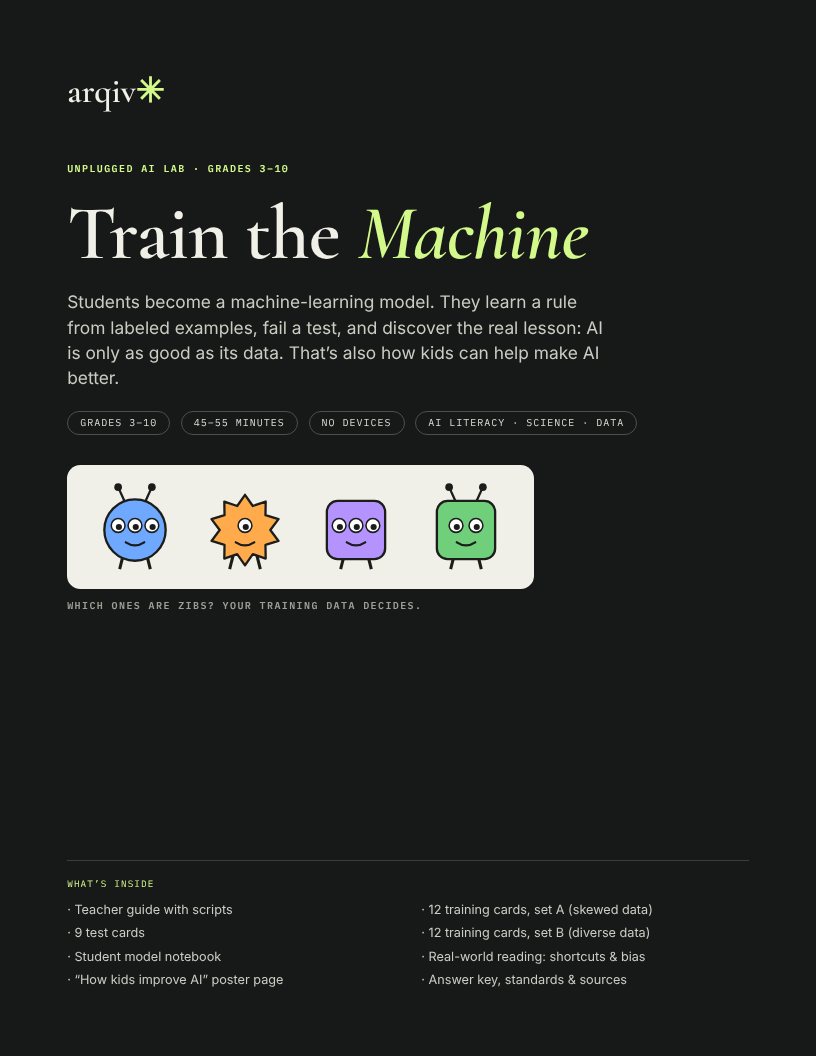
Train the Machine
Teams become a machine-learning model. They learn a rule from labeled creature cards, fail a test, and discover the real lesson: AI is only as good as its data. They also learn how people, kids included, make AI better.
What’s inside
- Teacher guide with scripts
- 33 creature cards (training sets A & B, test set)
- Student model notebook
- Real-world reading: shortcuts & bias
- “How kids make AI better”
- Answer key, standards & sources
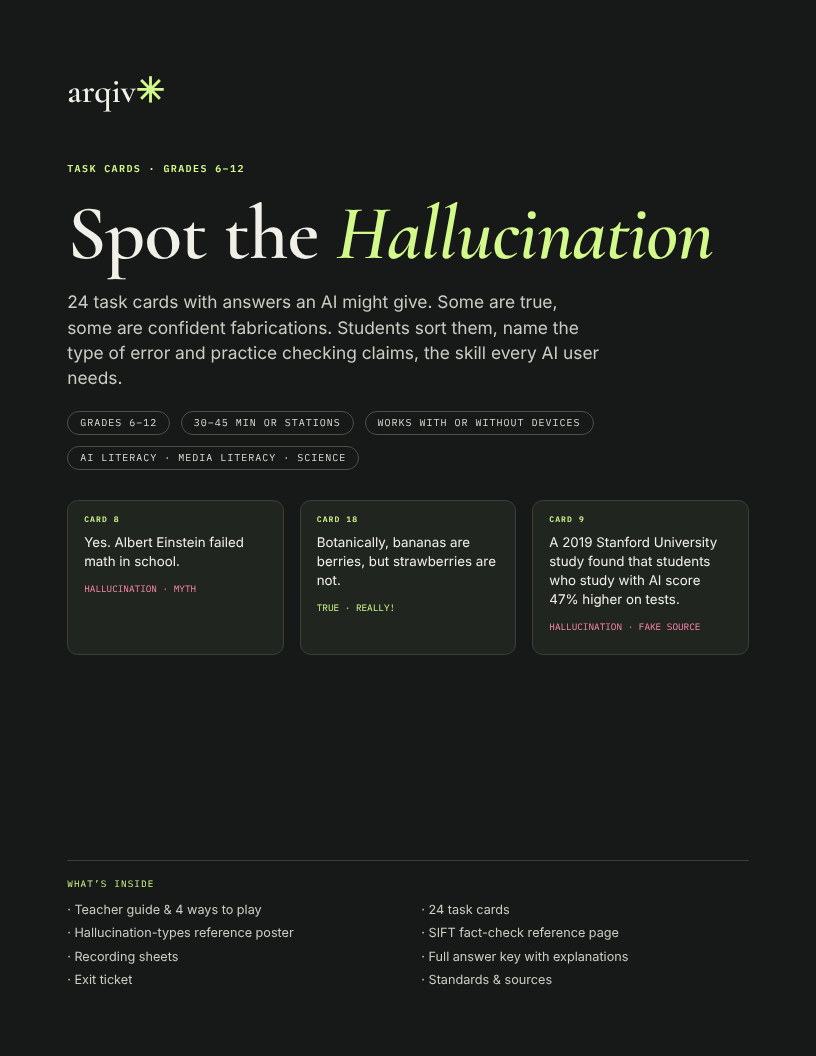
Spot the Hallucination
24 task cards with answers an AI might give. Some are true and some are confident fabrications: myths, fake sources, mixed-up details. Students sort them, name the error type, and practice the SIFT fact-check routine.
What’s inside
- Teacher guide & 4 ways to play
- 24 task cards
- 5 types of hallucination
- SIFT reference & red flags
- Recording sheets & exit tickets
- Full answer key with explanations
30 Think-First Bell Ringers
Six weeks of daily warm-ups that build thinking AI can’t replace. Monday: thought experiment. Tuesday: logic puzzle. Wednesday: would AI know? Thursday: estimate it. Friday: human, machine or ethics?
What’s inside
- 30 prompts, 2 per page (project or print)
- Daily themes for each weekday
- Weekly response sheet
- Teacher notes & answers
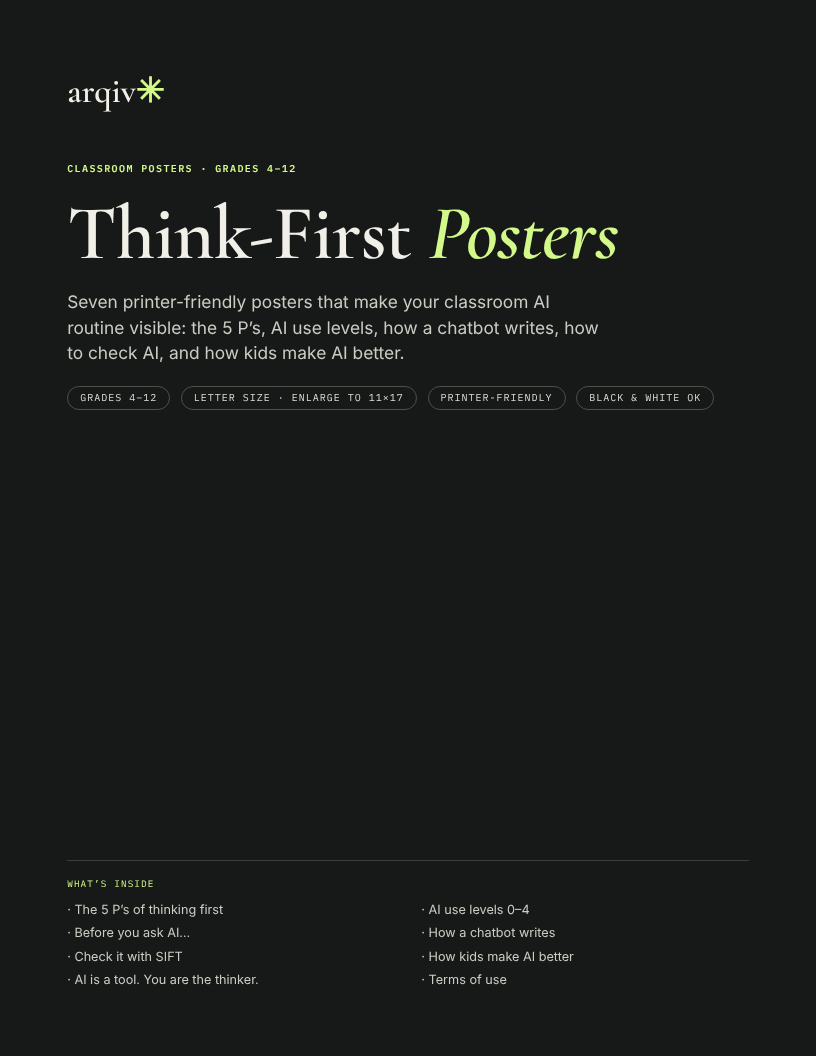
Think-First Classroom Posters
Seven posters that make your classroom AI routine visible: the 5 P’s, AI use levels 0–4, “Before you ask AI,” how AI writes, check it with SIFT, how kids make AI better, and “AI is a tool. You are the thinker.”
What’s inside
- 7 letter-size posters (enlarge to 11×17)
- Black & white friendly
- Matches every ARQIV lesson
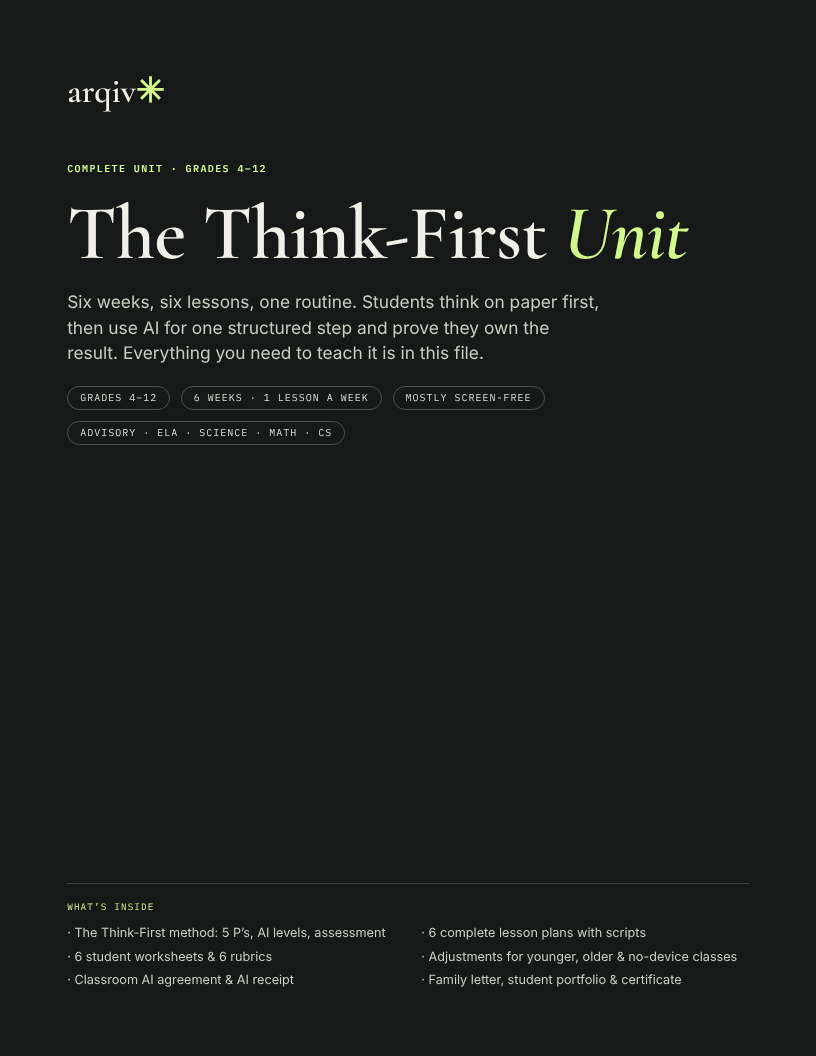
The Think-First Unit (6 weeks)
The full program in one designed, printable file: the Think-First method, six complete lessons with teacher scripts, student worksheets and process rubrics, plus the classroom AI agreement, AI receipt, family letter, student portfolio and certificate.
What’s inside
- The Think-First method: 5 P’s, AI levels, assessment
- 6 lesson plans with scripts & prep checklists
- 6 student worksheets & 6 rubrics
- Classroom AI agreement & AI receipt
- Family letter, student portfolio & certificate
- Adjustments for younger, older & no-device classes
Problem First: The Bus Challenge
Students solve a bus-and-budget problem on paper first, then test a confident but wrong answer against every rule of the problem.
Fact-Check the Bot
Students check four made-up bot answers against a calculation or a classroom record and defend a verdict: supported, contradicted or needs more evidence. Initial edition, not yet classroom-piloted.
Build an agent skill
Students write a skill (instructions an AI agent follows for one job) on paper, then a partner plays the agent and follows it literally. Includes a skill builder for your own planning. Initial edition, not yet classroom-piloted.
Classroom starter pack
Three investigations with ordinary classroom materials: test a prediction (the AI lesson), build a scale model, improve a paper bridge. Classroom draft, not yet classroom-piloted or standards-aligned.
Grades 6–12 Curriculum Guide
Twenty-four lesson outlines in four grade bands, with a standards crosswalk and assessment ideas. Outlines point to the ARQIV kit or lab to use; they are not scripted lessons.
Test the Models Kit
Report card, blind A/B sheet, a ten-prompt test bank with known answers, and a rubric.
Verify It Kit
SIFT cards, practice scenarios for three grade bands, and an answer key.
AI Tutor Prompt Cards
Twelve tutor prompts, the AI receipt and a think-first checklist for using AI without handing it the thinking.
Read Research Like a Scientist Kit
Detective checklist, six practice claims with a key, and a three-column sheet for a real study.
AI Model Field Guide
Model types, strengths and limits, and a one-page cheat sheet. Anything about specific models is dated.
No resources match these filters yet.
Also free, on the web
Lessons & labs you can use today
Every ARQIV lesson page prints cleanly, with a print button for the full plan and another for just the student worksheet.
Student AI labs
Next Word · Train the Machine 6 lessonsThink-First lesson library
Plans, scripts, worksheets, rubrics GuideThe Think-First guide
Policies, levels, assessment LessonFact-Check the Bot
Verify an AI answer Grades 6–8Classroom starter pack
Paper-first investigations ScienceAI in the world labs
Space · weather · health · moreFor schools & districts
Staff workshops and school pilots
Every resource here is free for any teacher to use with their students. To bring the Think-First routine to a whole staff, ask about a workshop or a supported pilot.
Put curiosity to work
Read it. Try it. Question it.
Explore new AI research, or take a paper-first investigation into your classroom.